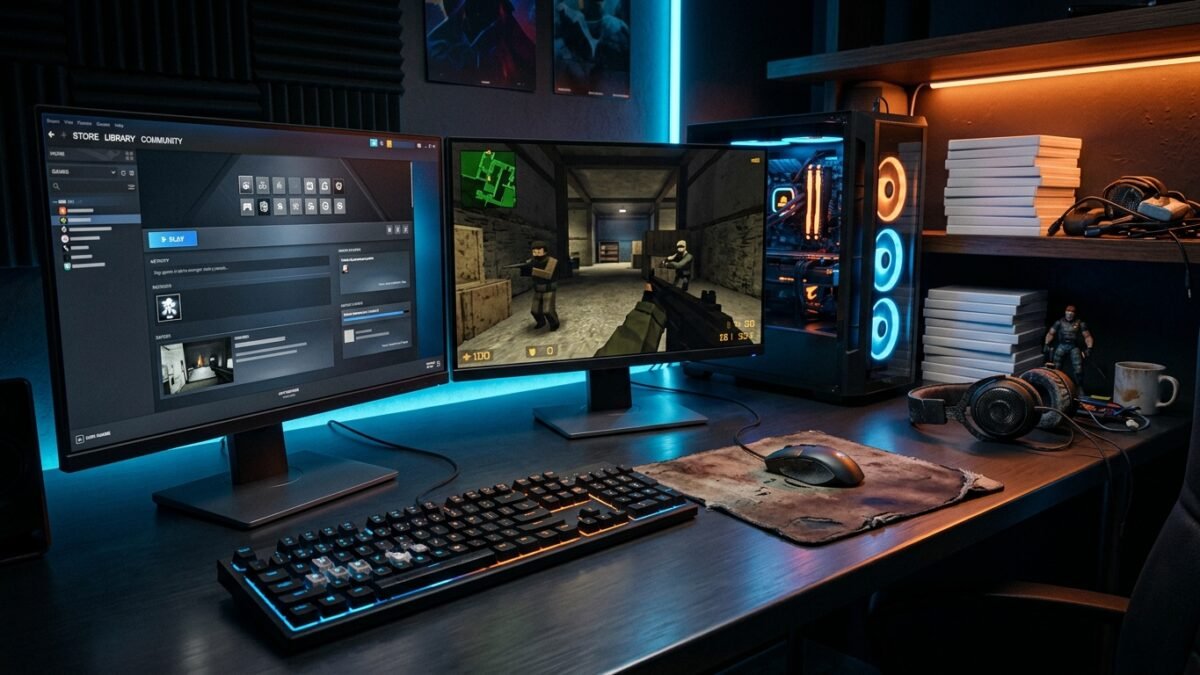
Valve never actually killed Counter-Strike: Global Offensive. In September 2023 it pushed the bulk of its player base onto Counter-Strike 2, and three years later the separated legacy client is still pulling 57,000 concurrent players as its own listing on Steam. That is a genuinely stubborn holdout audience. It is also a rounding error next to what CS2 is doing at the exact same moment.
As reported by Destructoid, the recently re-separated CS:GO client sits 28th on Steam’s most-played chart with those 57,000 players. Read on its own, that looks like a rebellion against Valve’s push to Source 2. Read against CS2‘s own numbers, roughly 955,000 concurrent players at the same time and a 24-hour peak above 1.4 million according to public Steam tracking data, it looks like something much smaller: a persistent niche that never made the jump, not a mass return.
Why Do Some Players Still Choose CS:GO Over CS2?
The honest answer is performance and muscle memory, not principle. When Valve first folded the old client into a beta branch inside CS2, competitive players who had spent a decade tuning their reflexes to CS:GO‘s netcode ran into a rockier port: reports of tick-rate changes, inconsistent frame pacing, and smoke rendering that behaved differently than what they had memorized. A promotional video sold the Source 2 rebuild as a clean upgrade, and for most of the player base it was one: sub-tick hit registration and the newer renderer genuinely improved the baseline experience for the players who switched. For a smaller slice, none of that mattered as much as the specific feel of a build they had played for ten years, and they simply never left.
That slice is small. Fifty-seven thousand against CS2‘s roughly 955,000 works out to under 6 percent. This is not a franchise in crisis. It is a franchise so large that even the piece Valve tried to retire still outnumbers plenty of actively marketed competitors. The gap also says something about how differently the two audiences are wired. Nobody is discovering CS:GO for the first time in 2026; every one of those 57,000 players is choosing a decade-old build on purpose, over a supported, actively patched sequel, which makes the retention harder to write off as simple inertia.
And on that narrower point, the comparison is genuinely interesting. Fifty-seven thousand concurrent players in a client with no marketing budget and no new content still outpaces Baldur’s Gate 3, a sprawling modern RPG that continues to draw a dedicated daily audience. It also beats Rainbow Six Siege, a live-service tactical shooter with a full production team pushing seasonal content, and Deadlock, Valve’s own actively promoted hero shooter. None of that proves CS2 is struggling. It proves how enormous the Counter-Strike audience is in aggregate, large enough that its own discarded leftovers can out-draw other studios’ flagship live-service bets.
The obvious counter here is that this is nothing but nostalgia, a number too small for Valve to care about. That’s largely fair. But Valve didn’t delete the old client outright. It kept CS:GO accessible and, per Destructoid’s reporting, recently gave it back its own separate listing rather than burying it permanently inside CS2‘s menus. A company willing to fully sunset old infrastructure when it wants to, see the original Steam-only Half-Life multiplayer mods, does not typically leave a genuinely irrelevant product visible on its own storefront page.
There is also a maintenance cost to that decision that rarely gets discussed. Running two live populations means two sets of matchmaking servers, two anti-cheat pipelines, and two codebases that occasionally need patching for the same exploit. Valve is not doing that out of sentiment. Fifty-seven thousand concurrent players still generate real matchmaking load, real skin-market activity, and real support tickets, and a company that size does not keep paying for infrastructure it considers dead weight.
What this actually shows is a franchise big enough to run two live populations at once without either one threatening the other. CS2 is not losing a war it does not know it’s fighting. It is carrying nearly a million concurrent players while a small, technically particular slice of the old guard keeps queuing into a decade-old build because it still feels the way they remember. Valve’s problem, if it has one, isn’t CS2‘s adoption. It’s deciding how much longer to keep maintaining a legacy client that refuses to hit zero.




Comments