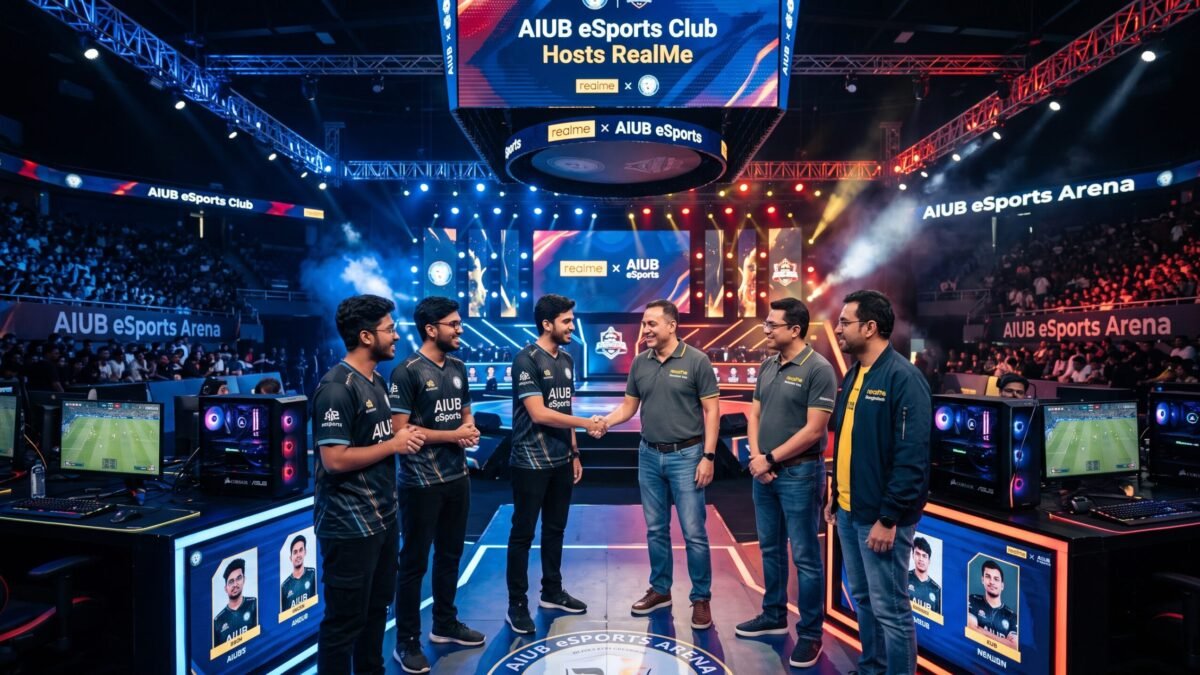
On Tuesday, June 23, 2026, the AIUB eSports Club hosted an official corporate delegation from RealMe Bangladesh and Southeast Asia to discuss collegiate gaming development. This bilateral meeting, held at the American International University-Bangladesh campus in Dhaka, marks a structured effort to align collegiate esports infrastructure with regional mobile hardware manufacturers. The visit focuses on establishing direct development pipelines for student players and organizing structured competitive events across the region.
Details of the RealMe Delegation Visit
The delegation from RealMe, a brand heavily associated with mobile gaming tournaments across South and Southeast Asia, met with the administrative heads and student leaders of the AIUB eSports Club. The discussions centered on physical infrastructure support, high-performance mobile equipment deployment, and the creation of dedicated training facilities within the university campus. While specific financial investments and hardware donation counts have not been announced, the initial framework targets the establishment of a dedicated mobile gaming arena at the university.
The AIUB eSports Club has historically been one of the active collegiate gaming organizations in Bangladesh. By hosting representatives from both the local Bangladesh branch and the wider Southeast Asian division of RealMe, the club aims to elevate its competitive standard. The meeting highlighted the need for stable tournament platforms, localized servers, and direct brand sponsorship for university-level tournaments. Representatives discussed potential pathways for top-performing student players to transition into professional esports organizations, utilizing RealMe’s existing network of sponsored professional teams in regions like Indonesia and the Philippines.
The Rise of Collegiate Gaming in Bangladesh
Collegiate esports in Bangladesh has experienced steady growth, driven by mobile titles such as PUBG Mobile, Free Fire, and Mobile Legends: Bang Bang. The American International University-Bangladesh has consistently supported these initiatives, recognizing esports as an official student activity under the Office of Student Affairs. This corporate visit indicates that international smartphone brands view the academic demographic as a primary market for competitive gaming development.
Historically, South Asian esports has operated independently from the highly developed systems found in Southeast Asia. This delegation visit serves as a structural link between the two regions. RealMe has previously organized community tournaments in Bangladesh, but partnering directly with an academic institution like AIUB allows the brand to establish a permanent presence. The club has not released the exact schedule for the upcoming tournament season, but representatives indicated that joint competitive events are in the planning stages.
What the Collaboration Means for the Region
This development points to a shifting strategy for hardware manufacturers in the region. Instead of focusing solely on professional-tier leagues, brands are investing in grassroots collegiate scenes to build brand loyalty and discover raw talent. For AIUB students, this provides a direct path to regional exposure, as the university club acts as a scout for international events.
How Will This Partnership Affect Local Tournaments?
The partnership is expected to result in the launch of co-branded collegiate tournament series, featuring dedicated prize pools and hardware rewards for participants. This structure will allow student players from AIUB and surrounding South Asian universities to compete under professional tournament conditions. It also opens up opportunities for student administrators to gain experience in tournament operations, broadcasting, and esports management, which are critical skills as the industry matures in Bangladesh.
By linking RealMe’s Southeast Asian division with the Bangladesh market, the initiative could also pave the way for cross-border collegiate invitationals. Currently, teams from Bangladesh rarely compete against established collegiate powerhouses from Malaysia, Singapore, or the Philippines due to a lack of institutional support and high-ping tournament servers. Addressing these technical and organizational barriers was a key topic during the June 23 meeting, signaling a concerted effort to integrate South Asian collegiate talent into the broader Southeast Asian competitive ecosystem. Related: SEA Esports Weekly: Global Esports Exit Masters London.



Comments