
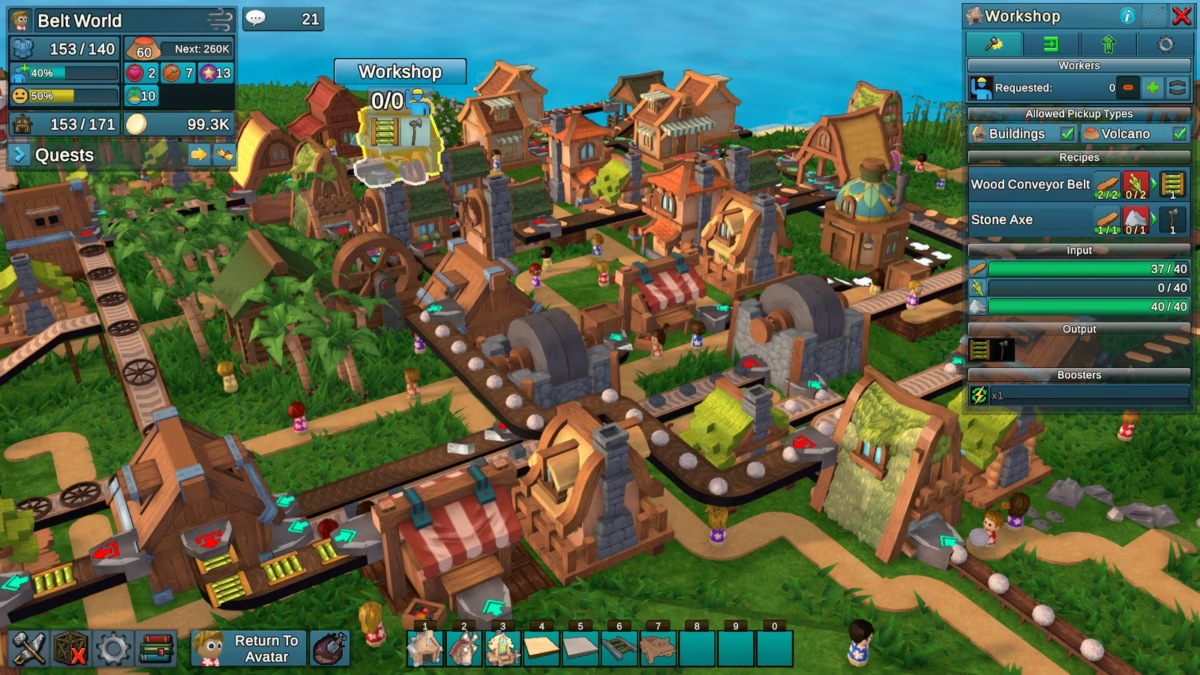
The automation genre currently suffers from a severe accessibility crisis. For the last several years, the most celebrated titles in the space have demanded a minor degree in logistics just to build a basic assembly line. Titles have become hostile to new players, prioritizing brutal efficiency and spreadsheet mathematics over actual enjoyment. Factory Town 2: Paradise rejects this sterile complexity. By wrapping complex industrial logistics in a vibrant tropical town-builder, the developers are showing that automation mechanics do not need to feel like a punishing second job.
The core premise sounds like a fever dream, but it works precisely because it refuses to take itself too seriously. As reported by Hardcore Gamer on July 15, 2026, players start completely alone on a tiny ocean sandbar. The only companion is a helpful, sentient volcano. That volcano eventually raises a proper island out of the ocean, providing wood, fruit, stone, wheat, and cotton. The final goal is not to strip-mine an alien planet. Instead, players are tasked with building a massive Rube Goldberg machine of industry to feed this cheerful volcano, which is actively trying to knock a comet away from hitting the Earth.
What actually matters here is the intentional softening of the factory genre’s learning curve. When Reddit users comment “Factory Town was my gateway to automation games.”, they are identifying a massive, underserved gap in the PC gaming market. The space between casual cozy town builders and punishing industrial simulators is vast and largely empty. This sequel targets that middle ground, using familiar tropes to introduce complex mechanical concepts without overwhelming the player in the first hour.
The Logistics of Feeding a Volcano
Time is the fundamental currency in any automation game. As the original reporting notes, “one person can do a lot of different things, and learn to do them well, but that still doesn’t change the number of hours available in a day.” A thriving town requires endless jobs to be performed constantly. You need a massive workforce to manage the load. Factory Town 2: Paradise handles this progression by tying human labor directly to basic resources.
The early gameplay loop is intentionally slow and readable. You start by walking up to trees and hitting the harvest button to gather logs. Those logs are used to build simple houses. Living space allows people to move to the island, providing the workers required to staff the various industries that will inevitably pop up. However, new workers will only arrive if the island is demonstrably happy. This requires players to build markets and keep them stocked with the best available goods.
This creates a brilliant, escalating cycle of demand. Harvesting raw wheat is a fine starting point, but the villagers will soon demand flour. To meet this need, players must place a harvester hut near the wheat field, build a windmill nearby, and connect the two with a physical chute. Once workers are assigned to both buildings, the wheat transfers automatically. When flour is no longer enough, players must spend research points to open up the bakery, combining an increasingly impressive amount of ingredients to create complex food items.
The sentient volcano acts as the primary governor of this entire economic system. Players cannot simply spam residential zones to brute-force a massive labor pool. The maximum size of your workforce is strictly dependent on the volcano’s current level. You must feed it high-quality manufactured goodies to grant it experience points. Each time the volcano levels up, the population cap increases, allowing more villagers to move in.
Is Factory Town 2 Too Simple for Factorio Fans?
The immediate counter-argument from hardcore logistics veterans is that a game relying on tropical fruit and happy villagers cannot possibly compete with heavy industry simulators. Players accustomed to the ruthless optimization of Satisfactory or Factorio might look at a cheerful volcano and basic wheat chutes and dismiss the entire experience as a shallow toy. They will argue that the automation genre requires high-stakes friction to remain engaging over hundreds of hours.
This perspective completely misreads how the late-game scaling functions. The initial, manageable sandbar eventually transforms into a cheerfully active, interconnected archipelago of tropical industry. Managing supply chains across multiple distinct islands while maintaining high villager happiness in every single settlement requires intense logistical planning. The complexity is absolutely present. It is simply hidden behind a welcoming aesthetic rather than a wall of brutalist, opaque menus.
Hardware Flexibility Over Factory Bloat
There is also a very real hardware limitation driving this design philosophy. A significant portion of the audience wants flexibility. When players explicitly state “I am looking for an automation game to play on my MacBook on the go.”, they are demanding titles that run cleanly on standard laptops without melting the processor. Rendering ten thousand moving conveyor belts on a dense factory floor requires serious hardware muscle. Related: PS5 and Xbox Series X Are Losing the War to PC Gaming.
By keeping the visual style clean and focusing the mechanics on localized production chains like the wheat-to-bakery pipeline, the developers ensure the game remains accessible across a much wider range of hardware. This intentional choice expands the potential audience far beyond the traditional desktop enthusiast crowd. It confirms that mechanical depth does not have to come at the cost of basic accessibility.
This approach successfully avoids a common development trap. We frequently see developers of accessible games feel pressured to add punishing, hardcore mechanics to satisfy a vocal minority of loud internet critics. Related: Stardew Valley’s Success Is a Trap Its Creator Cannot Escape. Factory Town 2: Paradise refuses to compromise its identity. It knows exactly what it wants to be, and it delivers that specific experience without apologizing for its cheerful tone.
The automation genre does not always have to revolve around environmental destruction and unchecked corporate greed. It does not have to feature bleak, grey environments stripped of their natural resources just to feed a mechanical beast. Sometimes the most effective way to teach a player complex supply chain logistics is to ask them to bake fresh bread for a friendly volcano.
The long-term success of this sequel will depend entirely on whether that late-game archipelago can maintain the readable charm of the initial sandbar. If the underlying math holds up without crushing the tropical aesthetic under a mountain of required micro-management, this release will set a new standard for the genre. Players who are exhausted by endless spreadsheets finally have a reason to start building again.
Featured image via hardcoregamer.com





Comments