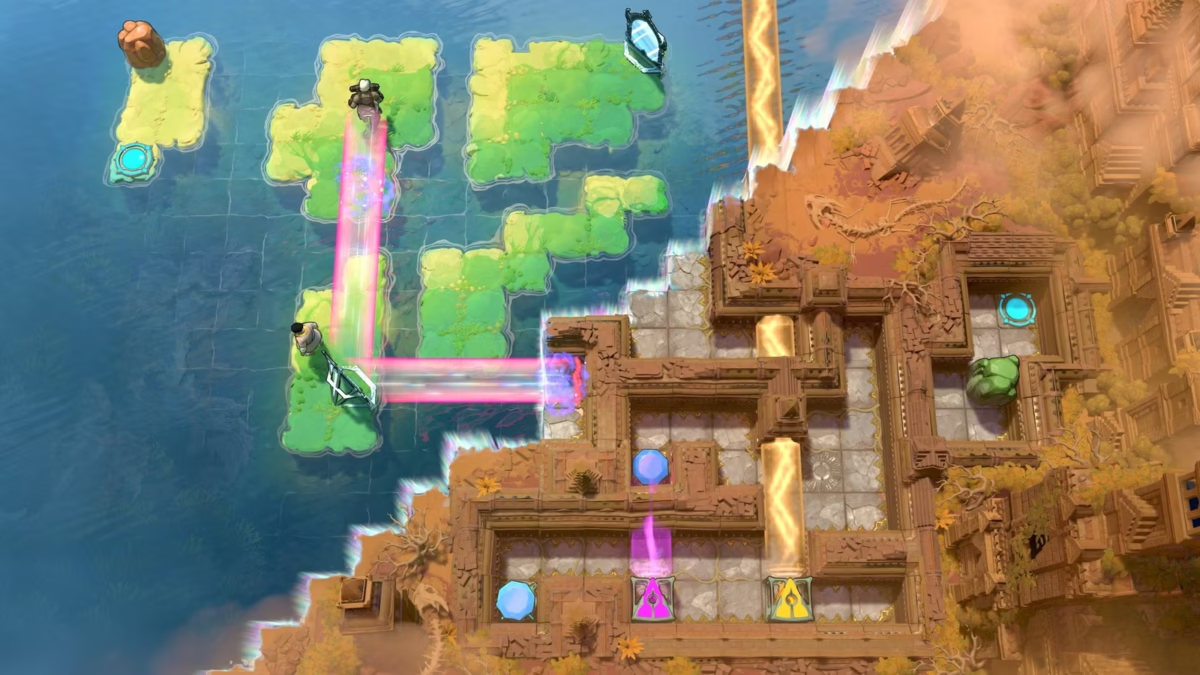
The official trailer for Order of the Sinking Star recently dropped ahead of Steam Next Fest, revealing a massive playable slice for the upcoming PC puzzle game. This pre-release build contains over 100 levels out of a planned 1,000-puzzle narrative adventure. Handing out ten percent of a heavily structured puzzle game for free is a staggering volume of content to give away before launch. This decision points to a harsh reality in the current PC indie market. Developers are no longer releasing demos just to gather feedback or tease mechanics. They are giving away significant chunks of their finished product because sheer volume is the only remaining way to secure visibility on a crowded storefront.
Releasing 100 levels upfront shifts the traditional unit economics of a puzzle game demo. Historically, a puzzle game slice provides a gentle onboarding curve. It introduces the primary mechanic, offers a handful of variations, and stops just as the difficulty spikes. The player hits a paywall right when they feel invested in solving the next logical step. Order of the Sinking Star is taking a radically different path. By offering 100 levels, the developer is essentially providing a full game’s worth of content for zero cost. For comparison, Jonathan Blow’s seminal puzzle game The Witness contained around 500 puzzles in its entirety. Giving away one-fifth of that volume for free suggests a strategy built entirely on conversion through overwhelming goodwill rather than calculated scarcity.
Player reception indicates this strategy is highly effective at generating immediate positive sentiment. Across discussion threads, Reddit users are already stating, “It’s so good,” with another noting, “It feels super smooth and overall is probably my favourite demo this Steam Fest.” This is the exact word-of-mouth momentum developers chase during these limited-time digital events. Fans reacting to the original trailer on YouTube echoed this enthusiasm, observing that “the demo will deliver a meaningful slice of the experience” ahead of the full launch. A meaningful slice is precisely what modern consumers demand before committing funds to an unproven intellectual property. However, satisfying players with a massive free experience carries a severe retention risk. If a player spends ten hours completing 100 free puzzles, they might simply feel satisfied and walk away without ever wishlisting the final product.
Why Are Steam Next Fest Demos Getting So Big?
The arms race of Steam Next Fest forces these massive content drops. Several years ago, a polished vertical slice of ten minutes was enough to capture media attention. Today, hundreds of games launch demos simultaneously during these week-long events. A short demo gets buried by lunchtime on day one. To stand out, developers must offer something that streamers can play for hours and that forum users can dissect for days. We saw similar aggressive visibility tactics recently when analyzing Why Mouseward Scrapping Soulslike Rules Is the Right Call, where sweeping design changes were deployed specifically to survive the Next Fest gauntlet. Order of the Sinking Star is using sheer scale as its marketing budget. The 100-level count is not just a feature. It is a loud, unavoidable billboard designed to force the Steam algorithm to pay attention.
This volume-first approach exacts a heavy toll on development resources. Polishing 100 levels to a public-facing standard months before release requires a massive reallocation of time. You cannot hide unpolished mechanics behind a “coming soon” screen when the player has access to an entire game chapter. Reviewing the build, CGMagazine noted that “while the demo build was fairly early on and the game is still a bit rough around the edges, there’s a lot of promise” in the mechanics. Exposing an early, rough build to a massive audience is a dangerous gamble. First impressions are rigid. If a puzzle game feels clunky during its free trial, players rarely return to check if the final release received a performance patch.
The developer’s promise of a 1,000-puzzle narrative adventure introduces an entirely different pacing problem. One thousand puzzles is an exhausting metric for any narrative-driven title. A puzzle game relies on constant mechanical escalation to stave off player fatigue. If the first 100 levels introduce the core spatial mechanics, the remaining 900 puzzles must introduce new variables, twist existing rules, and synthesize mechanics at a relentless pace to justify their existence. If the game resorts to padding or repetitive filler to hit that four-digit marketing claim, the narrative pacing will collapse under the weight of the puzzle count. It is a design challenge that has broken larger studios.
The true test for Order of the Sinking Star will arrive when the Next Fest spotlight fades. Securing praise for a free, smooth experience is a strong opening move. The developer now faces the financial hurdle of convincing an audience that just consumed 100 free levels to open their wallets for the remaining 900.



Comments