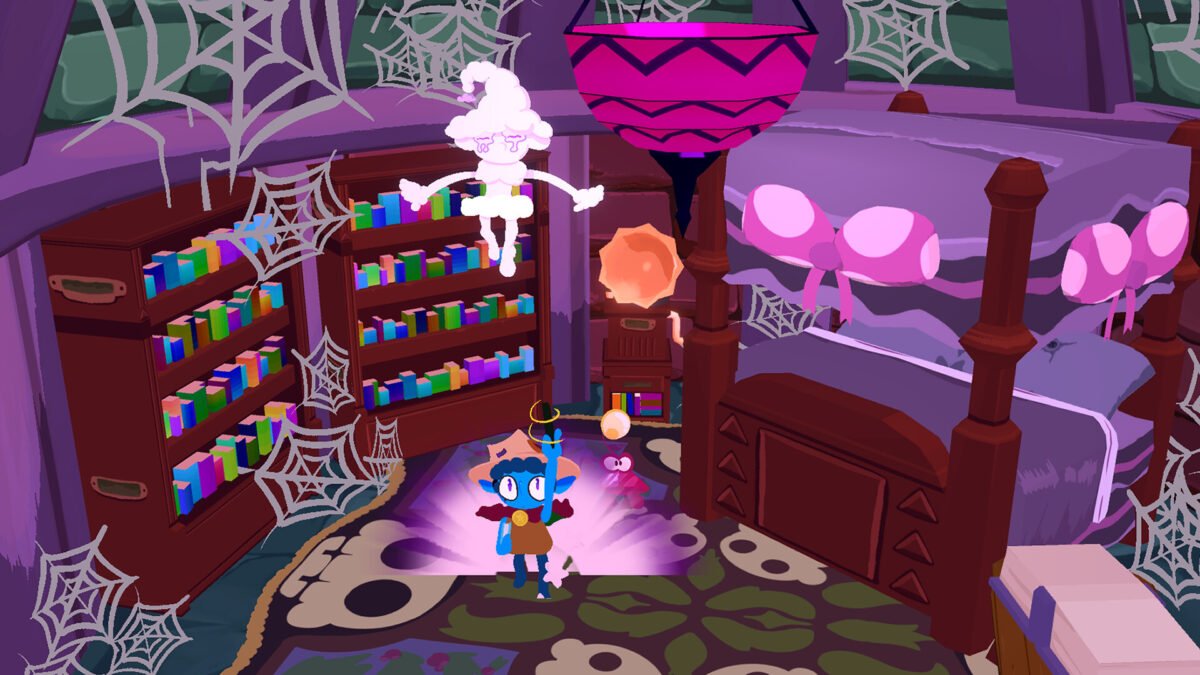
Puzzle design has spent the last decade terrified of the player. Developers increasingly lock us into pristine, single-solution boxes where creativity is punished in favor of finding the one correct sequence the designer intended. Rhell: Warped Worlds and Troubled Times throws out those safety rails entirely. Developer SlugGlove and publisher Yogscast Games are handing players a magic system so volatile it effectively dares them to break the game. This is not a guided tour through a curated museum of logic puzzles. It is a laboratory for magical chaos that trusts the person holding the controller.
As reported by Indie Games Plus, this semi-open world puzzle adventure tasks players with navigating nine distinct sections of a vanishing kingdom. You play as Rhell, a hot-headed mage awoken in her cell by a falling spell book. Armed with a push spell to move her cell door, she steps into a kingdom where the population has largely disappeared. The premise is simple, but the mechanics are absurdly deep. Players collect 40 different runes scattered across the map, from lava-filled mountains to serene crystal caves. The hook that elevates this above standard indie fare is how those runes interact.
You can combine up to five of these runes at a single time. The math on that yields over 100 million unique spell combinations. One Steam Community user is already calling it the “Best magic system of any game ever”, and the sheer volume of possibilities justifies that early enthusiasm. You are not just picking between a fire attack and an ice attack. You are combining fire, ice, push, and rise to see what the physics engine will tolerate. You can turn objects into water by mixing fire and ice, or transform them into metal using ice and goo. You can even summon dummies to cast these combinations for you.
We recently explored how rigid design is suffocating player agency when Slay the Spire 2 June Neowsletter Exposes the Genre’s Biggest Flaw. Rhell acts as the antidote to that rigidity. GameGrin accurately described the title as a “charming puzzler for those who want the freedom to get super creative with magic”. By giving players the tools to combine elements and bypass obstacles through sheer experimentation, the game shifts the burden of problem-solving from strict logic to physical experimentation.
Will This Spell System Ruin the Puzzle Balance?
It will absolutely ruin the traditional concept of balance, which is exactly why it works. When you give players 100 million ways to interact with an environment, you forfeit the ability to tightly control their progression. The appeal here is “accidentally breaking reality so hard the game just shrugs and lets it happen”, as one Instagram user perfectly summarized. If you want to bypass a locked door by freezing an object and propelling it across the room, the game allows it. The joy of discovery replaces the satisfaction of guessing the developer’s exact intention.
This approach shares DNA with Magicka or the recent physics sandboxes of modern The Legend of Zelda titles. It treats the player as an active participant in the simulation rather than a rat in a maze. Loot Level Chill noted that “Experimenting with spells is so much fun”, and that fun stems entirely from the modern processing power tracking those complex interactions. You are managing elemental reactions, summoning clones, and manipulating state changes across varied biomes. The game rewards you for looking at every object as a potential variable in a chaotic equation.
The Friction Required for Freedom
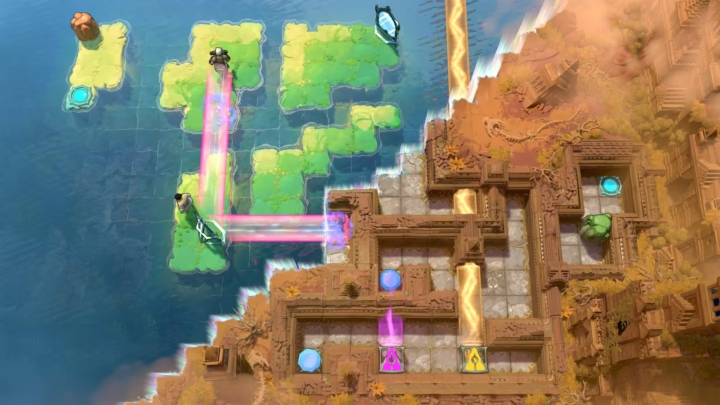
The strongest argument against this level of mechanical freedom is that a puzzle ceases to be a puzzle if you can just blast your way through it with an overpowered combination. If every problem can be solved with the same five-rune sequence, the nine sections of the world lose their mechanical distinctness. A wooden barrier that needs burning down is no longer a puzzle if you always have a fire spell ready. SlugGlove anticipates this by introducing seals. These are specific zones or floor buttons that strip Rhell of her casting ability or block dummy summons. A waterfall might constantly extinguish any fiery object that gets close, forcing you to reconsider your approach.
This is a necessary friction. Without these restrictions, the 100 million combinations would flatten the difficulty curve into a straight horizontal line. The seals force players to actually engage with the specific environment of the crystal caves or the rope bridges, rather than simply brute-forcing their way out of a corner. It prevents the player from optimizing the fun out of the experience, a trap that many open-ended games fall into. The presence of your companion, a gem-bug named Beesle who can highlight important objects, ensures that players are never entirely lost in the weeds of their own spellcraft.
GameCube Nostalgia Hides a Modern Engine
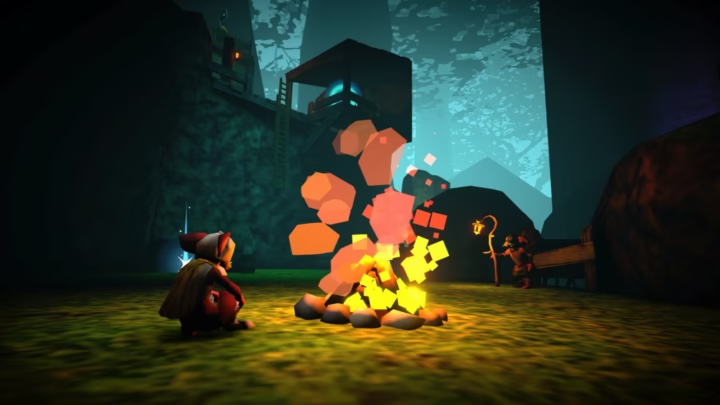
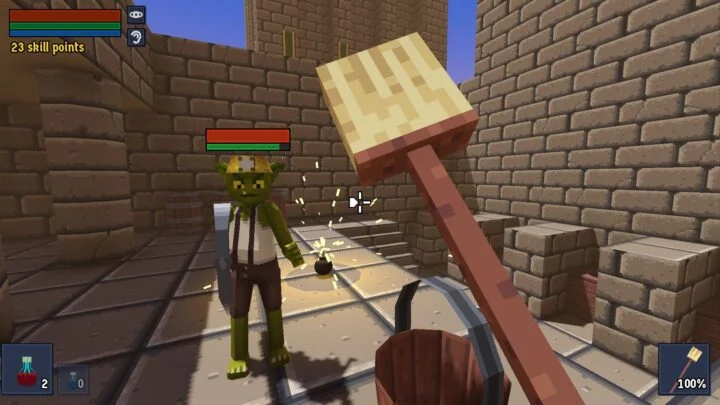
Much like we saw when Cassette Beasts 2002 Abandons Its Retro Identity and Bets on Combat, the visual presentation of Rhell: Warped Worlds and Troubled Times is actively deceiving. The game is styled as a retro throwback, heavily leaning into the recommended 4:3 aspect ratio. Players can fill the screen borders with curtains, banner collages, or checkerboards, mimicking the experience of playing on a bulky CRT television. It looks like a forgotten relic from the early 2000s. Yet beneath that flat, colorful art style is a deeply systemic physics engine that simply could not have existed during the era it emulates. The contrast between the simplistic, stylized visuals and the staggering complexity of the modular magic system creates a fascinating dissonance.
Exploration is directly tied to this mechanical depth. Because there are 40 runes scattered across the map, rushing through the main story path is a mathematical disadvantage. The game litters its world with jelly beans and coins to reward completionists, but the real prize is always another verb to add to your spell book. Every new rune exponentially increases your options, turning a previously unsolvable room into a playground of elemental reactions.
The puzzle genre needs this exact kind of disruption. For too long, developers have prioritized pristine, unbreakable level design over genuine player expression. By leaning into the chaos of a 100-million-combination magic system, Rhell: Warped Worlds and Troubled Times trusts the player to be clever rather than just compliant. The final product might occasionally break under the weight of its own possibilities, but a game that bends to your will is infinitely more engaging than one that forces you into a predetermined mold. SlugGlove has built a sandbox that begs to be broken, and players should accept the invitation.



Comments