
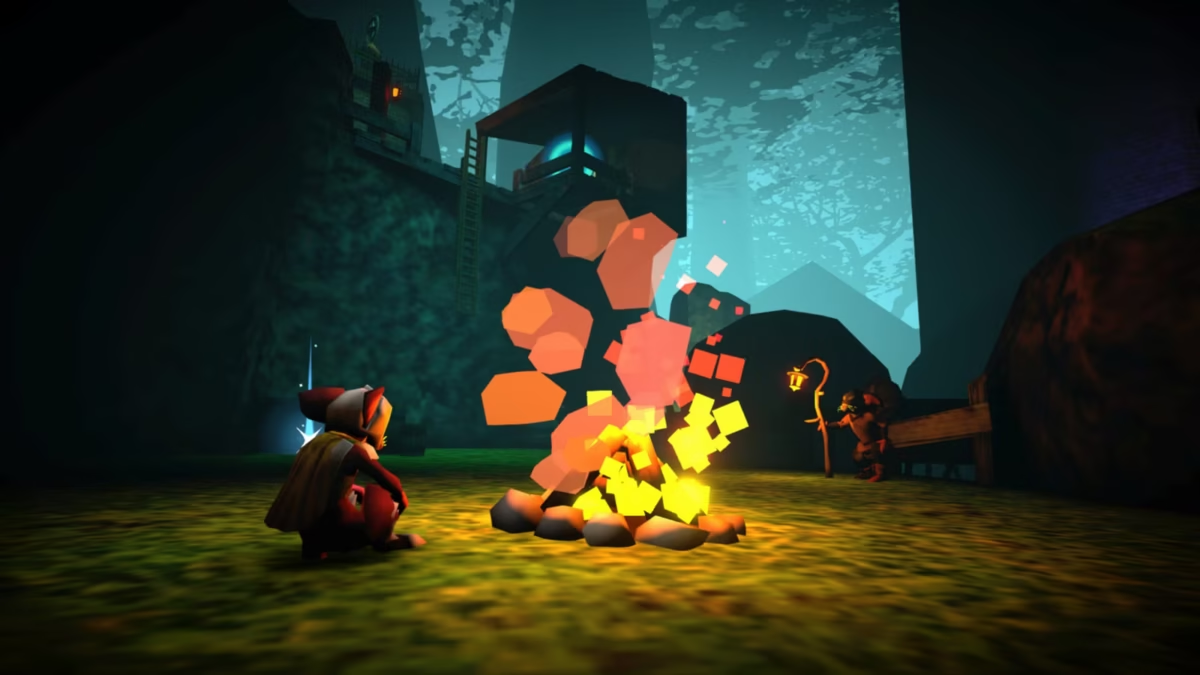
The indie scene has a habit of taking two disparate concepts and smashing them together until something works. On May 21, 2026, developer and publisher Finite Reflection Studios released a playable demo for Mouseward. The project pitches itself as a retro-themed soulslike collectathon. You play as Martin Fieldmouse, a deceased member of the Royal Mouse Guard resurrected to fight against the tyrannical religion of The Natural Order in the world of Terrene. The setup sounds like a random word generator, yet the Steam community response indicates a mechanical success. The demo currently holds a 100 percent positive rating across 67 user reviews.
What makes Mouseward succeed where countless other genre hybrids fail is its rejection of modern action-RPG bloat in favor of PlayStation 2 era presentation. By looking backward, Finite Reflection Studios solves a modern design problem. In a standard soulslike, exploration is often punished. You wander into the unknown, die, and lose your accumulated currency. Mouseward softens this friction by layering Nintendo 64 style collectathon mechanics over the hostile environment of Oakbridge. Hitting pause in a region displays an exact count of coins, equipment pieces, and fallen stars available in that zone.
This transparency alters the player psychology. Fallen stars act as permanent stat upgrades at the campfire. Finding a full three-piece armor set, consisting of leggings, a helmet, and a chestplate, grants a unique passive ability like an attack strength bonus after a successful block. If a player misses an item, they can spend stardust dropped by defeated enemies to pinpoint its general location. The genre usually relies on obscure punishment to build tension. Mouseward uses literal checklists to encourage poking into every corner, suggesting that knowing what you are looking for does not diminish the satisfaction of surviving the search.
Will This Change How Soulslikes Handle Difficulty?
The inclusion of accessible difficulty settings directly challenges the foundational elitism of the soulslike genre. Before taking on the initial zombie mice outside Oakbridge, the game presents a choice between a toned-down accessible adventure and the full soulslike experience. Giving players a choice does not break the mechanical loop. The deliberate combat pacing remains intact, but the penalty for failure scales to the player.
We see massive studios struggle with this exact balance of approachability and mechanical depth.
Related: we have seen major sequels play it entirely too safe to avoid alienating their base.
Finite Reflection Studios is taking a risk by explicitly labeling their game a soulslike while immediately offering an escape hatch from the associated frustration. It suggests that the appeal of the genre is the methodical combat and atmospheric exploration, not just the sheer numerical punishment of a tiny health bar.
There is a rich history of rodents navigating brutal retro environments, and the nostalgia attached to them is potent. During the Super Nintendo era, Rocky Rodent established a reputation as an incredibly polarizing hidden gem. Looking back at community discussions of that 90s title, you find players expressing a mix of trauma and adoration. One Reddit user noted that “Rocky Rodent had me fully convinced I was insane…” while another fiercely defended it as one of the “Most underrated retro games of all time.” Mouseward taps into that exact same chaotic energy. It evokes the memory of renting a bizarre platformer on a Friday night and getting entirely stuck on the second level.
The difference is execution. Hardcore Gamer notes the obvious aesthetic comparison to Yacht Club Games and their upcoming title Mina the Hollower. Both feature brave mice in dark 3D retro worlds. However, where Mina the Hollower appears focused on refining the 8-bit action-adventure formula, Mouseward aims at the clunky ambition of early 3D console titles. The low-poly aesthetic is not just a visual filter. It informs the level geometry, the scaffolding you climb, and the obscure rooftops you jump across to find hidden equipment.
Related: the booming market for dedicated retro handhelds shows players are actively seeking out this specific era of visual design.
Finite Reflection Studios is operating in a crowded market. Dozens of indie action games launch every single week on Steam. Standing out requires more than a cute protagonist wrapped in rags and armed with a sword. The 67 players who left positive reviews for the May 21 demo are responding to a specific synthesis of ideas. The game respects the player’s time by tracking collectibles, respects their skill level by offering difficulty toggles, and respects the history of the medium by lifting the best elements of PS2 era exploration.
The industry relies far too heavily on standardized genre labels that restrict developer creativity. A game must either be a grueling test of reflexes or a breezy item hunt. Mouseward rejects that binary. It asks why a player cannot enjoy the deliberate swordplay of a modern dark fantasy while simultaneously checking off a list of hidden coins like it is 1998. The developers have built a system where the punishment of combat is offset by the joy of discovery. Finite Reflection Studios has provided the mechanical blueprint, and it is up to the rest of the indie sector to see if they can balance their own item economies just as effectively.



Comments