
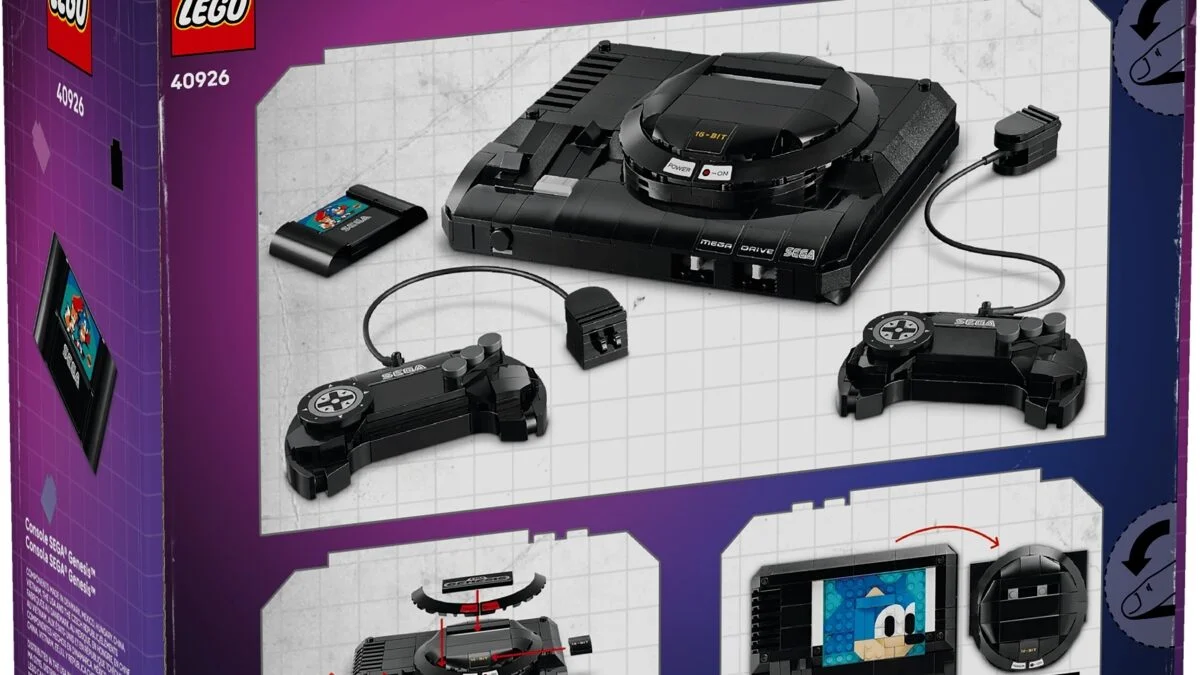
There is a specific kind of shadow that falls over a desk when you realize your childhood has been neatly packaged into a series of interlocking plastic blocks. The announcement that Lego and Sega are collaborating to bring us a buildable, tiny Sega Genesis is not just a toy release; it is a calculated diagnostic of the modern gamer’s psyche. As a journalist who has seen the rise and fall of the 16-bit wars, I find the intersection of Sonic the Hedgehog and Danish engineering to be both fascinating and deeply cynical. We are no longer just playing games, we are archiving them in the most expensive, non-functional ways possible while the actual hardware rots in attics across the globe.
The Deep Dive: Mapping the 16-Bit Blueprint
The core of this narrative analysis begins with the realization that Lego and Sega have finally decided to monetize the specific aesthetic of 1989. This set is not a functioning console, nor does it pretend to be, yet it occupies a space in our collective memory that demands technical precision. When we look at the Gamespot Coverage of this announcement, it becomes clear that the appeal lies in the tactile reconstruction of a machine that once challenged Nintendo for the soul of the living room. The kit features the iconic circular volume slider and the power switch that once felt like a gateway to a digital frontier. For a veteran gamer, building these components is an exercise in muscle memory translated into ABS plastic, even if the result will never output a single pixel of 320×224 resolution.
The inclusion of a buildable cartridge of Sonic the Hedgehog serves as the emotional anchor for this product. This is not the first time Lego has dipped its toes into the gaming world, but it represents a shift toward the older, high-income enthusiast who values the silhouette of a console over the actual gameplay loop. We are seeing a trend where the physical representation of the hobby is becoming more valuable than the software itself. It is a strange reality where a plastic model costs more than a subscription to a service that allows you to play the entire library of the console it replicates.
The Performance & Experience Autopsy
From a technical perspective, the “performance” of a Lego set is measured in build fidelity rather than frames per second. However, for the gamer, the experience is inextricably linked to the hardware’s history. The Sega Genesis was defined by its Motorola 68000 processor and the aggressive “Blast Processing” marketing that defined an era. When you sit down to build this set, you are engaging with a physical abstraction of that power. There is no DLSS to smooth out the edges of these bricks, and there is no firmware update to fix a missing piece. The reality of the gamer is shifted from the screen to the instruction manual, where the only latency is the time it takes for your fingers to find the right 1×2 plate.
The tactile feedback of clicking pieces together replaces the click of a cartridge being seated into a slot. For many, this provides a sensory satisfaction that digital emulation cannot replicate. This is where the technical data meets the human element; the specific dimensions of the Lego bricks are designed to evoke the proportions of the original 1989 Japanese hardware. It is a simulation of ownership that bypasses the need for a CRT television or a working motherboard. It is clean, it is static, and it is entirely devoid of the technical glitches that made the original hardware a living, breathing machine.
The Economic Landscape
Understanding the “Why” behind this collaboration requires a look at the business strategy employed by both Lego Gaming Official and Sega. The toy industry has discovered that gamers are the perfect demographic for high-margin, collectible sets. While a digital copy of a game might retail for ten dollars, a physical Lego set can easily command a hundred dollars or more. This is an economic pivot away from software sales and toward lifestyle branding. Sega, in particular, has mastered the art of licensing its legacy because it no longer carries the overhead of manufacturing actual consoles.
By partnering with Lego, Sega is able to maintain brand relevance without the risks associated with the hardware market. It is a low-risk, high-reward scenario where the fans do the assembly work. The margins on plastic are significantly higher than the margins on silicon and copper, especially when you consider that the research and development costs for a Lero set are fraction of what it takes to launch a new gaming platform. This is the new frontier of gaming business; selling the memory of the game rather than the game itself.
Industry Impact: The Miniature Arms Race
The impact of this release ripples across the entire industry, affecting how Sony, Microsoft, and Nintendo view their back catalogs. Nintendo paved the way with the Lego NES, proving that there is a massive market for brick-built consoles. Now that Sega has entered the fray, we are seeing the 16-bit wars reignited on the shelves of toy stores rather than the aisles of electronics retailers. This shift suggests that the “Mini Console” craze of the late 2010s has evolved into a “Buildable Console” era. It is a more sustainable model for manufacturers because it avoids the complexities of software licensing and hardware failure rates.
For the consumer, this means that our history is being curated by toy companies. If a console doesn’t have a recognizable silhouette, it likely won’t get the Lego treatment. This prioritizes the visual iconicism of the Sega Genesis or the NES over the actual cultural impact of the games they played. We are witnessing the “toyification” of gaming history, where the messy, technical reality of the past is smoothed over by the clean lines of modern manufacturing. It changes the way future generations will perceive these machines; not as tools for entertainment, but as decorative objects of a bygone age.
Market Counterpoint: The Nostalgia Trap
There is a vocal segment of the market that argues these sets are a pure celebration of gaming culture, a way to display one’s passion without the clutter of old wires and yellowing plastic. They claim that Lego brings a level of artistry to the Sega Genesis that a simple plastic shell cannot match. However, this perspective ignores the fact that these products are effectively a tax on nostalgia. By positioning these sets as “Adult Welcomed” collectibles, companies are exploiting the disposable income of a generation that is desperate to reclaim a piece of their youth.
Dismantling this perspective requires looking at what is lost. When we prioritize the plastic model over the preservation of the original software, we are participating in a shallow version of history. A Lego set cannot tell you what it felt like to experience the speed of Sonic for the first time on a cold Saturday morning. It cannot replicate the sound of the FM synthesis chip. It is a silent monument that offers the aesthetic of gaming without any of the substance. To call it a “celebration” is to ignore the commercial machinery that turns our memories into a quarterly earnings report.
The Jay Respawns Take: A Noir Verdict
I sit here looking at the press release, and I see the rain on the glass reflected in the polished surfaces of those tiny black bricks. The Lego Sega Genesis is a beautiful ghost. It is a meticulously designed piece of engineering that captures everything about the console except for the reason we loved it. We are living in an era where the industry wants to sell us the box, the manual, and the plastic, but they would rather we didn’t worry about the actual code. It is a noir reality where the past is a commodity that is repackaged every few years to see if our wallets have grown heavier as our hair has grown thinner.
If you want a piece of art for your shelf, this set is a triumph of design. It captures the essence of Sega better than any recent corporate initiative. But as a gamer, I find it hard to shake the feeling that we are being sold a distraction. We are building the tomb of the 16-bit era, brick by brick, while the actual spirit of that innovation is lost to time and proprietary launchers. Buy it for the build, but don’t mistake it for the magic. The magic was never in the plastic; it was in the glow of the screen and the calloused tips of our thumbs. For more official updates, keep an eye on Sega Press Releases as they continue to navigate their legacy. Related: Invincible On Nintendo Switch: Why The Bloodiest Superhero IP Is A Genius Move For Nintendo.


Comments