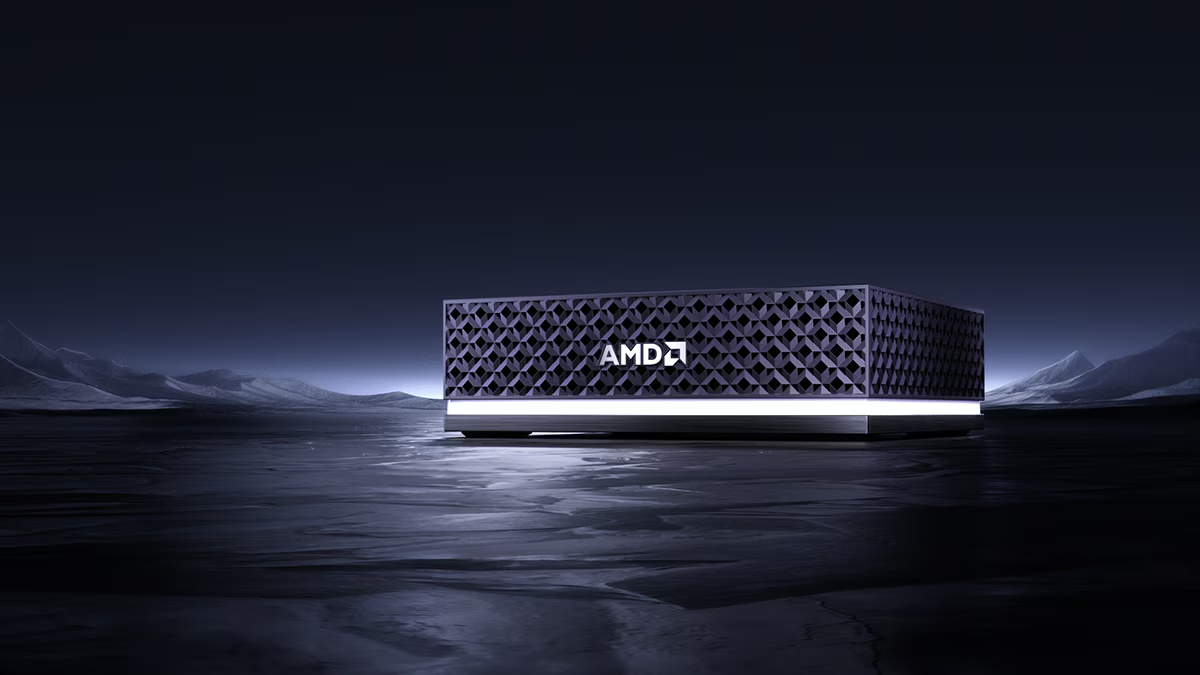
AMD’s $3,999 Ryzen AI Halo is a bet that ROCm is finally ready and that developers are tired enough of cloud GPU bills to find out. Whether that bet pays off depends less on the chip than on how much of your workflow lives outside CUDA. The launch of this hardware introduces a new category, packing 128GB of unified memory into an ultra-compact x86 system that undercuts its closest direct competitor by exactly $680, though buyers can already find the same silicon in GMKtec’s $1,999 alternative.
The real bet AMD is making here is not that the Ryzen AI Max+ 395 beats Nvidia’s Tensor cores. It is that ROCm is finally mature enough in 2026 that a developer choosing between cloud GPU bills and a local box might pick AMD rather than extend another Nvidia subscription.
Machine learning professionals who require local data privacy and high-capacity memory without the thermal output or space requirements of enterprise hardware represent the core audience for this machine. First revealed by AMD CEO Dr. Lisa Su at CES 2026, the device utilizes the Ryzen AI Max+ 395 system-on-chip, featuring 16 Zen 5 cores and 32 threads with a 3GHz base and 5.1GHz boost clock. AMD soldered 128GB of LPDDR5X-8000 unified memory directly to the mainboard, feeding a massive 40-compute-unit Radeon 8060S integrated graphics processor. The layout overcomes standard desktop memory channel limitations by providing massive memory bandwidth.
The anodized aluminum chassis measures 149 x 149 x 43.2mm and weighs just over 1kg. It is remarkably light.
Despite the small footprint, the price tag places it squarely in the professional tool category. Evaluating its market position requires analyzing actual performance metrics, software optimization, and alternative hardware configurations.
Is 128GB of unified memory cost-effective here?
For teams that require an x86-based system that functions immediately out of the box, the financial math works. While assembling a custom desktop with 128GB of system RAM is straightforward, running large language models on standard system CPUs yields low efficiency because of memory bandwidth limitations. To achieve acceptable generation speeds, the processor must have high-speed, direct access to the memory pool.
Apple silicon represents a prominent option for local AI development in the compact hardware segment. AMD claims a 4x AI performance advantage over the Apple Mac Mini M4 Pro, which is limited to a maximum of 64GB of unified memory. Accessing 128GB or more within the macOS ecosystem requires moving up to the Mac Studio, where custom configurations quickly exceed the $4,000 threshold.
A more direct comparison exists with the NVIDIA DGX Spark, which launched with similar compact ambitions. Global supply-chain constraints affecting high-density NAND flash and LPDDR5X memory forced Nvidia to raise the price of the DGX Spark to $4,679, meaning the $3,999 pricing of the Ryzen AI Halo represents a lower entry cost for hardware procurement.
The most revealing detail in this launch is not the chip, it is the price gap within AMD’s own product family. GMKtec’s EVO-X2 runs the identical Ryzen AI Max+ 395 with the same 128GB for around $1,999. AMD’s official kit charges $2,000 more for pre-configured software, AMD direct support, and 10GbE networking. Developers who have compared both note that the premium is defensible for a corporate lab needing a supported, deployable platform. For a solo researcher, that gap is harder to justify.
The financial calculations change if a desktop form factor is acceptable. Experienced hardware builders note that a budget above $3,000 can fund a custom full-tower PC. For example, utilizing a chassis with multiple PCIe Gen4 slots allows the installation of two refurbished enterprise GPUs, which provides 48GB of ultra-fast VRAM. While such a DIY setup easily outperforms integrated systems, it demands a 1600-watt power supply, generates substantial heat, and occupies a large physical space.
Who should avoid this hardware?
Enterprise AI teams working within established corporate pipelines should avoid this platform, as their production codebases almost certainly rely on Nvidia enterprise management tools and multi-node clustering. Researchers whose work relies entirely on custom CUDA extensions, proprietary Nvidia libraries, or Triton kernels will face persistent integration friction. For these users, the time spent translating code to run on AMD silicon represents a significant operational cost that quickly eclipses the $680 hardware savings.
Developers running models under 32B get better tokens-per-dollar from a discrete GPU. Those with RAG pipelines or agent workflows that process large context windows repeatedly will feel the DGX Spark’s 5x prefill advantage every hour. AMD’s own break-even math assumes sustained heavy usage, but independent analysis puts the realistic payback period closer to 33 months for a single developer, not the six months AMD claims. Furthermore, ROCm breaks the moment you leave standard inference for fine-tuning, custom kernels, or TensorRT-dependent workflows.
Comparing the Ryzen AI Halo and the NVIDIA DGX Spark
The competition between AMD and Nvidia in the compact AI workstation market highlights the difference between raw memory capacity and software-driven architectural efficiencies. AMD has a lower purchase price, but Nvidia delivers faster processing in specific operational phases.
In raw token generation, the two platforms perform similarly. When running the gpt-oss 120B model, the Ryzen AI Halo achieves approximately 34 tokens per second. The Nvidia DGX Spark delivers approximately 39 tokens per second on the same model. This difference of 5 tokens per second is minor during real-time human reading of text outputs.
Prefill speed, or prompt processing, reveals a significant performance gap. The DGX Spark processes prompts approximately 5x faster than the Ryzen AI Halo. When feeding large codebases, long chat histories, or massive text documents into the system, the Nvidia hardware initiates its response almost instantly, whereas the AMD system experiences a noticeable processing pause.
Independent testing has shown that the prompt processing speed of the Ryzen AI Halo slows down as the context window expands. Image generation tasks and workloads run through vLLM also show slower processing times on the AMD silicon compared to the Nvidia equivalent. The following table details the hardware specifications of both compact systems:
| Specification | AMD Ryzen AI Halo | NVIDIA DGX Spark |
|---|---|---|
| Processor / SoC | AMD Ryzen AI Max+ 395 (16 Zen 5 Cores / 32 Threads, 3GHz Base / 5.1GHz Boost) | Nvidia proprietary ARM/Grace-based or custom SoC |
| Cache | 16MB L2, 64MB L3 | Proprietary architecture cache |
| Graphics / Compute | Radeon 8060S (40 RDNA 3.5 CUs) | Nvidia Tensor Core GPU |
| NPU Performance | XDNA 2, 50 TOPS | Nvidia TensorRT integrated |
| Unified Memory | 128GB LPDDR5X-8000 (Soldered) | 128GB LPDDR5X unified |
| Storage | 2TB PCIe Gen4 SSD | 2TB high-speed NVMe SSD |
| Networking | 10GbE LAN, Wi-Fi 7 (2×2), Bluetooth 5.4 | 10GbE LAN, Wi-Fi 7, Bluetooth 5.4 |
| Dimensions | 149 x 149 x 43.2 mm (Aluminum, ~1kg) | Similar ultra-compact form factor |
| gpt-oss 120B Speed | ~34 tokens per second | ~39 tokens per second |
| Prefill / Prompt Speed | Standard baseline | ~5x faster than Halo |
| Current Price | $3,999 | $4,679 |
What does 128GB unified memory unlock in practice?
Having 128GB of LPDDR5X-8000 unified memory running at 34 tokens per second changes the scope of local development. Researchers can load a 120-billion parameter model like gpt-oss 120B at Q4 quantization directly into this capacity, leaving ample headroom for context storage. This setup allows teams to run deep code-generation models locally, parsing entire repository structures without sending intellectual property to external cloud APIs.
At 34 tokens per second, the system generates text faster than an average human reads. Interactive, multi-turn conversations and real-time agentic workflows run locally on a desk at this throughput. Engineers can run complex agent loops, where one model generates code, another tests it, and a third audits the output, all within the same unified memory pool.
This memory capacity also supports high-resolution image generation pipelines and multimodal models. At 128GB, most ComfyUI workflows, text-to-image, control nets, upscaling pipelines, are unlikely to hit out-of-memory errors that would otherwise require offloading to disk. The unified architecture ensures that the CPU and GPU share the same physical memory space, eliminating the latency associated with transferring data across a PCIe bus.
Software integration and the ROCm 7.2.2 ecosystem
Silicon specifications represent only one aspect of developer adoption. Nvidia has spent over a decade establishing its proprietary CUDA platform as the industry standard, meaning most machine learning libraries and repositories are written specifically for Nvidia hardware. AMD has historically struggled to provide seamless software compatibility, often requiring manual workarounds from users.
To address this, the Ryzen AI Halo includes official support for ROCm 7.2.2, AMD’s open-source compute platform. The system ships with pre-configured software environments, including LM Studio, ComfyUI, and VS Code, which allows users to deploy local models immediately. AMD also bundles 5 pre-loaded local playbooks and 10 online configuration guides to assist developers in porting existing CUDA projects over to the ROCm ecosystem.
The ROCm 7.2.2 release represents a significant software step, introducing native support for key deep learning libraries and reducing the setup friction that plagued earlier versions. AMD has focused on optimizing PyTorch execution, ensuring that standard Hugging Face transformers run without modification. This software layer translates standard execution calls to run on the RDNA 3.5 architecture, narrowing the gap in user experience between AMD and Nvidia systems.
Despite these integration efforts, software hurdles remain. Many cutting-edge models published on public repositories still expect native CUDA environments, meaning developers utilizing highly customized kernels may still need to write manual translation layers.
Operating system licensing is straightforward. AMD offers the system pre-loaded with either Windows 11 Pro or Linux. Both OS options cost the same, ensuring that engineers who require a Linux environment for containerized development do not face an additional licensing fee.
Market alternatives and future hardware variants
For buyers who find the $3,999 entry price prohibitive, third-party manufacturers are expected to offer alternative form factors using the same underlying architecture. Hardware partners such as Minisforum are projected to release Strix Halo-based mini PCs that are approximately $300 to $700 cheaper than AMD’s official developer kit.
These third-party platforms will likely reduce costs by altering physical specifications. They may use plastic enclosures instead of the milled aluminum chassis found on the official developer kit. They might feature standard Wi-Fi 6E networking or smaller 1TB solid-state drives. Crucially, these partner systems are unlikely to include the pre-configured software stacks, local playbooks, and direct optimizations provided by AMD.
The consensus among those who have tested Strix Halo hardware is that AMD’s actual competition here is not the DGX Spark, but rather the $1,999 third-party Strix Halo boxes already on the market. Developers who have run both recognize that the $2,000 premium for the official kit buys software readiness and direct AMD support, rather than superior silicon. This represents a defensible value proposition for a corporate lab, but it remains much harder to justify for a solo developer.
For hobbyists comfortable with configuring drivers and setting up software environments manually, these upcoming partner systems represent a viable alternative. It is a DIY path. However, corporate development environments may find that the out-of-the-box readiness of the official platform justifies the higher initial cost. Looking ahead, AMD has confirmed that a Ryzen AI Max+ PRO 495 variant is expected in Q3 2026, which will support up to 192GB of unified memory for more demanding workloads.
Retail availability and acquisition
Acquiring the Ryzen AI Halo requires navigating a restricted distribution model. Following the initial Ryzen AI Halo pre-orders in June, physical units are expected to become available on July 10, 2026. AMD has partnered exclusively with Micro Center for the United States launch, restricting all sales to in-store pickup only.
The Micro Center-only launch is not a logistics quirk. It signals that AMD expects buyers to be institutions, university labs, R&D teams, AI startups with a physical Micro Center nearby, not individual developers ordering online.
If you are running models larger than 32B locally every day and your workflow depends on Windows-native tooling, the Halo makes a defensible case at $3,999. If you are not at that threshold yet, the GMKtec EVO-X2 runs the same chip for $1,999 less, or cloud inference remains cheaper until your usage crosses the 33-month break-even AMD’s own math does not advertise.





Comments