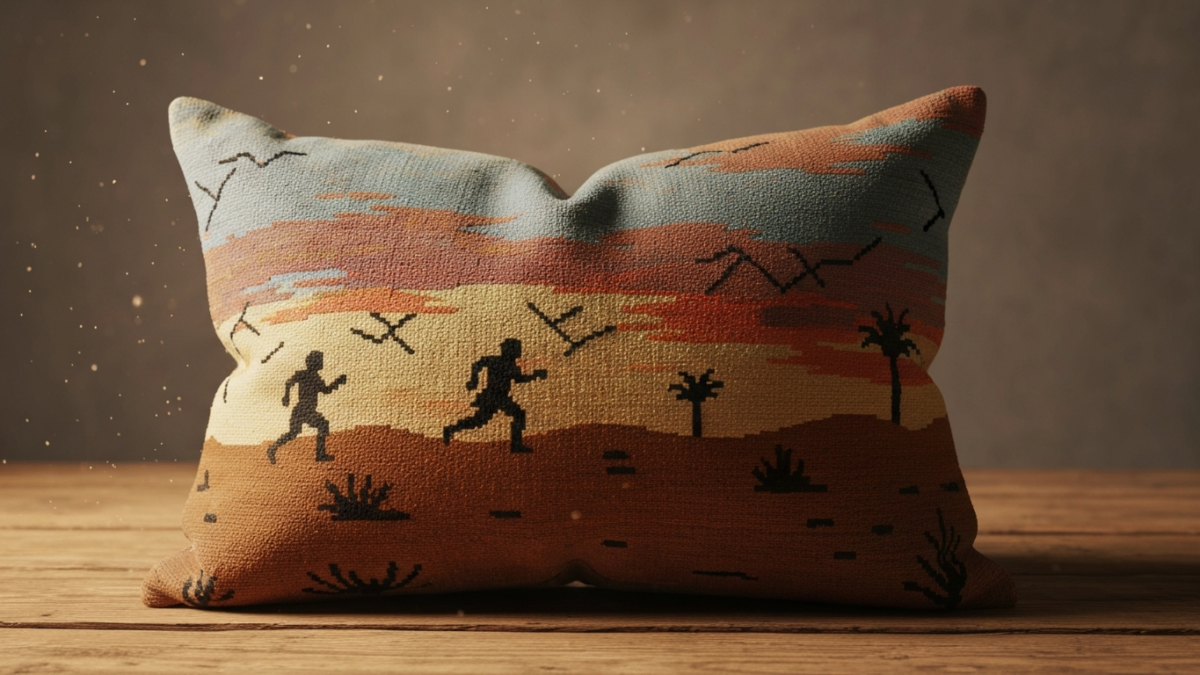
The gaming industry often finds itself trapped in a cycle of sanitized escapism; however, every few years, a project emerges that demands we look at the medium as a legitimate vessel for historical memory and radical empathy. Dreams on a Pillow is one of those projects.
Originally announced in late 2024 by Palestinian developer Rasheed Abueideh, the creator of the poignant Liyla and the Shadows of War, this “pseudo-stealth adventure” has recently reached a major milestone. As the developer shared on the official Steam page, full production has officially commenced. This announcement comes alongside a first look at gameplay that is as haunting as it is narratively daring. As reported by Rock Paper Shotgun, the game is set during the 1948 Nakba, the ethnic cleansing that saw the violent displacement of Palestinians from their ancestral lands.
While many titles use historical settings as mere window dressing for power fantasies, Dreams on a Pillow appears to be doing something far more vital: it is using the mechanics of play to process the mechanics of trauma.
The Context
The timing of this development update is inextricably linked to the ongoing violence in the region. Rasheed Abueideh has stated that the game serves as an emotional response to the attacks on Gaza that began in 2023, grounding the historical 1948 setting in a very contemporary sense of grief.
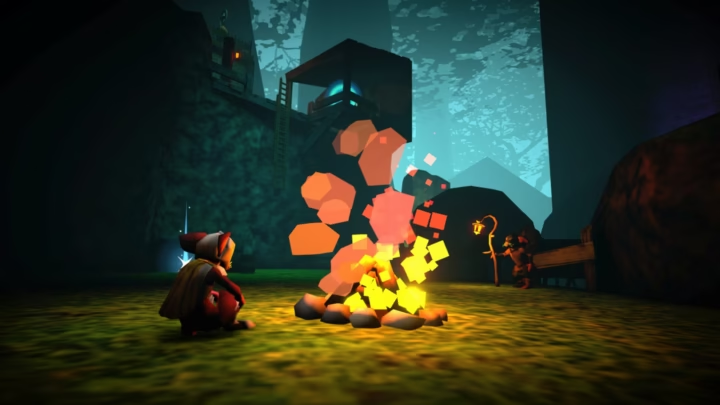
The gameplay reveal focuses on Khadra, a young woman inspired by a Palestinian folktale. In the chaos following the massacre of her village, Khadra attempts to flee with her newborn child, only to realize in her state of shock that she has accidentally grabbed a pillow instead of her infant. This central, tragic metaphor forms the core of the experience. Unlike the high-octane stealth seen in major franchises, the “pseudo-stealth” here is a tool for survival and psychological navigation.
The game is slated for a 2027 release window, joining a growing list of ambitious titles targeting that year. While we have seen major publishers like Sega Sammy reveal a massive game slate through 2027, the stakes for an independent project like Dreams on a Pillow are entirely different, relying on community support through platforms like LaunchGood to maintain its independence.
The developer confirmed that the core team is now assembled across all disciplines, establishing production pipelines that will carry the project through the next two years. This shift into full production is a significant hurdle for any indie studio, particularly one operating under the immense pressures of the West Bank.
The roadmap for the game is clear, much like the ARC Raiders roadmap extending into early 2027, but where ARC Raiders focuses on technical loops and player retention, Dreams on a Pillow is focused on a gameplay loop that mirrors the stages of displacement: Reality, Nightmares, and Dreams. It is a structure designed to prevent the player from ever feeling truly comfortable, forcing them to inhabit the headspace of someone whose world has been irrevocably shattered.
The Analysis
The mechanical implementation of Khadra’s pillow is perhaps the most striking element of the gameplay reveal. In most games, an item is a tool for progression or a stat-boost; here, the pillow is a psychological anchor. The trailer demonstrates that without the pillow, the game world transforms into a nightmare landscape, visually representing Khadra’s trauma.
This creates a fascinating tension; the player must protect and carry an object that is, in reality, a symbol of a devastating mistake. It is a subversion of the typical “escort mission” trope. Instead of protecting a vulnerable NPC, you are protecting a physical manifestation of a broken mind. This kind of genre-blending, where emotional narrative dictates mechanical shifts, is reminiscent of how some developers are creating a farming and horror hybrid to unsettle players, but Dreams on a Pillow applies this to a real-world historical atrocity, which carries far more weight.
- The Visual Duality: The game begins by depicting contemporary 1948 Palestine as lush, colorful, and vibrant. This is a deliberate choice to humanize the setting before the onset of the Nakba, ensuring the player feels the weight of what is lost.
- The Village of Al Tantura: The inclusion of specific historical locations, such as the fisherman’s village of Al Tantura, grounds the poetic folktale elements in documented history. This makes the game a digital archive as much as a piece of entertainment.
- The Three-State Loop: By shifting between Reality, Nightmares, and Dreams, the game avoids a linear progression of misery, instead reflecting the fragmented nature of memory and survival.
- Pseudo-Stealth as Vulnerability: The stealth mechanics are not designed to make the player feel like a predator. Instead, they emphasize the precariousness of Khadra’s existence as she moves toward the hope of safety in Southern Lebanon.
- Cultural Preservation: By drawing on Palestinian folktales, Abueideh is reclaiming a narrative that has often been suppressed or ignored in Western media, using the global reach of Steam to ensure these stories are heard.
Furthermore, the decision to depict the lead-up to the conflict is vital. Too often, media depicts marginalized groups only in the context of their suffering. By showing Khadra’s life in Al Tantura as “lush and beautiful” in the early hours of the game, Abueideh establishes a baseline of humanity. This makes the subsequent descent into the “Nightmare” state mechanically and emotionally jarring. It is a sophisticated use of the medium that many AAA studios avoid for fear of alienating broad audiences, yet it is exactly what is required for gaming to be taken seriously as an art form.
The Jay Respawns Position
At Jay Respawns, we often talk about frame rates, hardware specs, and sales figures, but we must also talk about what games are actually saying. Dreams on a Pillow is an uncomfortable game, and that is exactly why it is necessary. There is a vocal segment of the gaming community that constantly cries out for “no politics in games,” but that demand is a fantasy.
Every game is a product of its environment, and to ask a Palestinian developer to ignore the history of the Nakba while his community faces modern displacement is an absurdity. This game is a radical act of witness. It uses the interactive nature of gaming to do what a film or a book cannot; it makes you responsible for Khadra’s survival, forcing you to navigate her trauma alongside her.
The “pillow” mechanic is a masterclass in narrative design. It takes a poetic, heartbreaking concept and turns it into a core gameplay pillar. This isn’t just about “playing” through history; it is about feeling the weight of it. When the world turns nightmarish because Khadra loses her grip on her surrogate child, the player experiences a fraction of the disorientation and terror that defines the refugee experience.
This is the true power of the medium. We should be championing developers who are brave enough to use their tools to tell stories that are difficult, divisive, and deeply human. Rasheed Abueideh is not just making a game; he is building a monument to a story that many would rather see forgotten.
We must also acknowledge the bravery required to develop such a project in the current climate. Funding a game via LaunchGood and pushing for a 2027 release while living through the very themes the game explores is a feat of artistic endurance. While we wait for more updates on its progress, the gaming public should look at Dreams on a Pillow as a litmus test for the industry. If we can celebrate the technical wizardry of the latest blockbusters, we must also find the space to support and analyze games that challenge our perspective and force us to confront the world’s most painful realities. This isn’t just a “difficult, poetic picture,” as some have described it; it is a necessary evolution of the craft.
Dreams on a Pillow is a haunting reminder that gaming’s greatest strength isn’t escapism, but its ability to force us to walk in someone else’s shoes.


Comments