
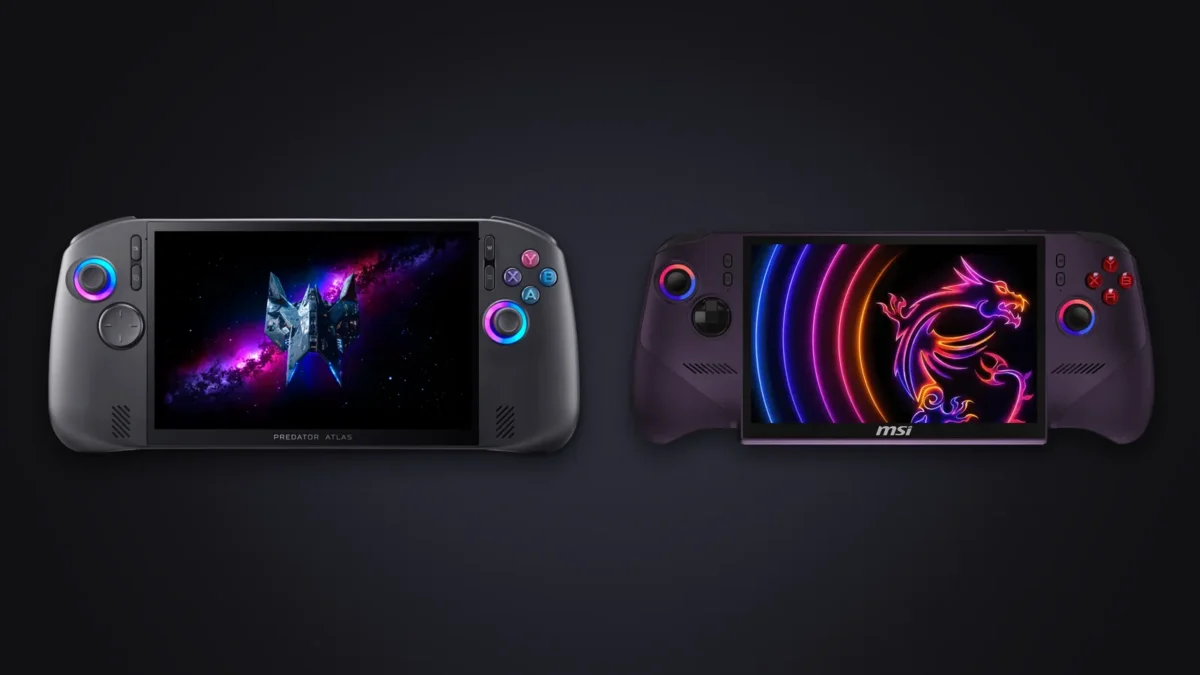
The $500 launch gap separating the Acer Predator Atlas 8 and the MSI Claw 8 EX AI+ shrank to $350 within two weeks. When Acer launched its handheld on November 1, 2026, it instantly sold out at $1,299.99. As of November 16, Best Buy lists the Atlas 8 back in stock at $1,449.99 following a 10-day price hike. Meanwhile, the Claw launched at $1,799.99 at the MSI Store, a price Best Buy matches as of November 16, while Newegg offers the same configuration for $1,709.99. Prices were checked live on November 16 and have moved once already; verify listings before buying.
So what actually matters right now? The unstable pricing makes headlines, but the real story is whether paying extra for the Claw buys meaningful usability or just memory specs. My read is simple: the Claw is the better machine, the Atlas 8 is the better deal, and that deal shrank when the gap narrowed from $500 to $350. Both push the exact same 14-core Intel Arc G3 Extreme silicon. They divide sharply on memory allocations, storage expansion hassle, physical weight, and software maturity. The real decision comes down to how much headroom you need for Windows background tasks, whether you are willing to tear open a chassis to swap the SSD, and what happens when you unplug from the wall.
Specs and Pricing Breakdown
Check live store pages before buying, as listing updates have altered the gap between these models.
| Feature | Acer Predator Atlas 8 | MSI Claw 8 EX AI+ |
|---|---|---|
| Price (US) | $1,449.99 at Best Buy (Nov 16); $1,299.99 at launch | $1,799.99 at Best Buy; $1,709.99 at Newegg |
| Processor | Intel Arc G3 Extreme (14 Cores) | Intel Arc G3 Extreme (14 Cores) |
| Graphics | Intel Arc B390 | Intel Arc B390 |
| Memory | 24GB LPDDR5X | 32GB LPDDR5X-8533 |
| Internal Storage | 512GB NVMe SSD | 1TB NVMe SSD |
| Display | 8-inch 1920×1200 IPS, 120Hz VRR, 500 nits | 8-inch 1920×1200 IPS, 120Hz VRR, 500 nits |
| Battery Capacity | 80Wh | 80Wh |
| Weight | 867g measured (Acer rates it under 810g) | 784 grams |
| US Market Status | On sale Nov 1, 2026; sold out at launch, in stock at Best Buy now | On sale since June 2026 |
Where does the performance actually land?
Run both at 35W TDP and the framerate difference evaporates.
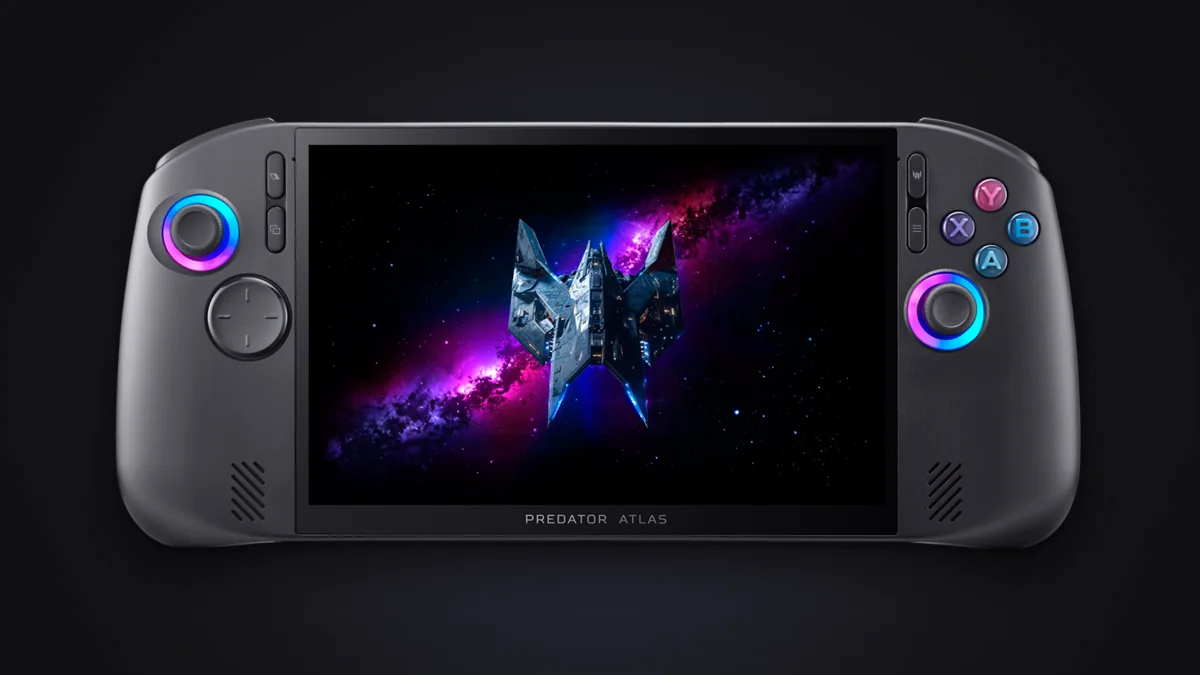
Gizmodo matched both devices at 35W and recorded virtually identical average performance across their test suite. The Atlas may hold higher 1% lows, and the Claw can reach higher peak performance because its maximum TDP is 45W. The Arc G3 Extreme itself ran roughly 30 to 40 percent faster than AMD’s Ryzen Z2 Extreme on average. In their benchmarking, Forza Horizon 6 at 1080p High returned about 50 fps on the Atlas compared to roughly 37 fps on the Ally X20.
At 35W, chip speed is a tie.
In 3DMark Time Spy runs at 35W TDP, ETA Prime recorded the Atlas 8 at 6,607 points. The older ROG Xbox Ally X reached 4,091 points in the same test, trailing the Atlas by about 38 percent. The Claw 8 EX AI+ scored above 7,000 points, putting it at least 6 percent ahead of the Atlas, though its exact TDP setting was not specified in the run. ETA Prime also logged the Atlas 8 playing Forza Horizon 6 at 1200p medium without upscaling at over 70 fps on 30W. Notebookcheck noted the Atlas’s 35W Turbo mode struggled in that game, which it put down to software. The same suite showed Crimson Desert averaging 78 fps at 1200p High with 2x XeSS multi-frame generation at 35 to 40W.
PC Guide recorded native 1200p runs on the Atlas 8 in Turbo mode, showing Cyberpunk 2077 at 80 fps on Medium and 56 fps on Ultra. Counter-Strike 2 logged 56 fps on Very High, while Doom Eternal reached roughly 95 fps on Ultra Nightmare. Testing an Intel-provided engineering unit, Engadget measured 95 fps in Cyberpunk 2077 on the Claw at 35W FHD Medium with XeSS Performance upscaling, compared to 62 fps on the Xbox Ally X.
What does the extra money actually buy?
Paying up buys extra RAM and double the internal storage capacity.
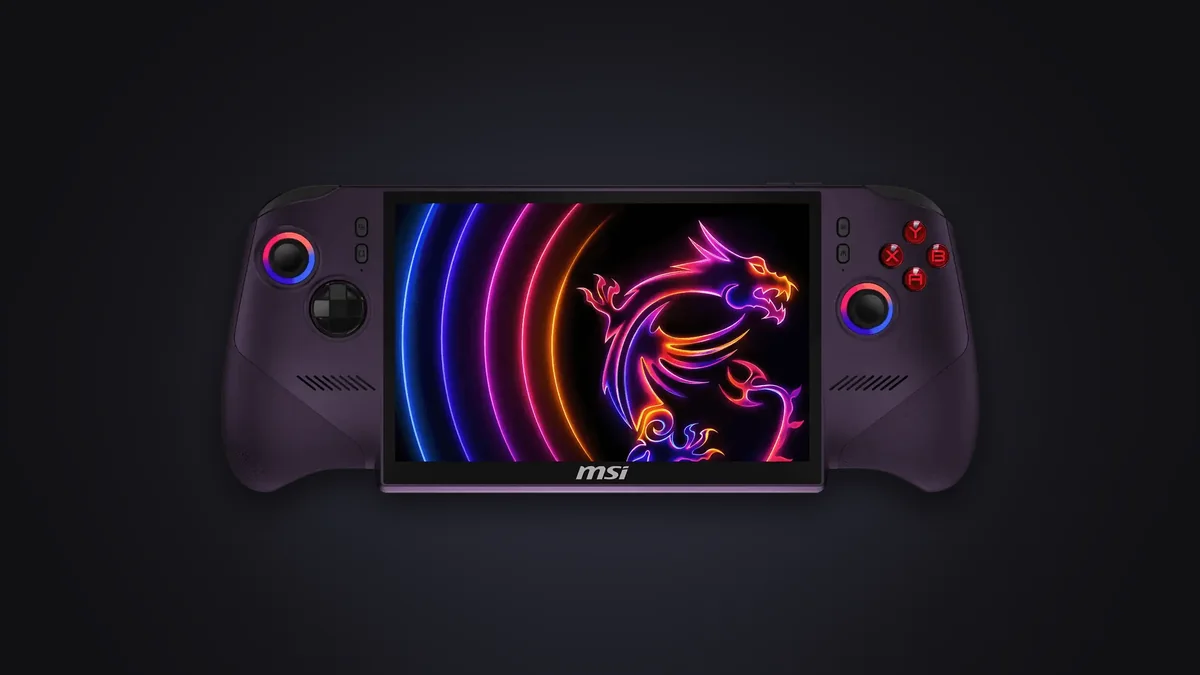
The US Atlas 8 ships with 24GB of LPDDR5X RAM and a 512GB SSD. The Claw provides 32GB of LPDDR5X-8533 memory and a 1TB SSD. Club386 confirmed these fixed allocations, leaving US buyers without an official higher-spec Atlas option.
Gizmodo called 512GB a bare amount, recommended buying a microSD card, and noted they uninstalled and reinstalled games near-daily. Expanding storage presents different headaches on each handheld. Per Gizmodo, the Claw requires microSD Express cards while the Atlas takes standard microSD cards. PC Guide found the Atlas’s internal NVMe drive awkward to swap because cooling parts and ribbon cables obscure the slot.
Weight marks the other major physical difference between these handhelds. The Claw weighs 784 grams. Acer rates the 80Wh Atlas 8 at under 810 grams, but an early owner weighed their unit at 870 grams. PC Guide measured their Atlas test sample at 867 grams, roughly 83 grams heavier than the Claw. Acer’s rating and two independent weigh-ins differ by roughly 57 to 60 grams.
The weight gap is real but small.
Software track records and hardware ergonomics
Acer is entering the US handheld market without a track record.
The Atlas 8 is Acer’s first US handheld, while the Claw 8 EX AI+ builds on the previous Claw 8 AI+. Initial setup on the Atlas reflects that early software stage. PC Guide noted configuration required multiple reboots and separate update passes across Windows, the Microsoft Store, and Acer Live Updates, with some apps rendering poorly until display scaling was reduced. Gizmodo highlighted daily quirks: sleep mode requires holding the power button for a full second, RGB lights blink while sleeping, and fans spin up after display sleep. Adjusting TDP requires opening the full PredatorSense application, while Intel drivers require the separate Intel Graphics app. An early owner reported a broken sleep mode that leaves system fans running.
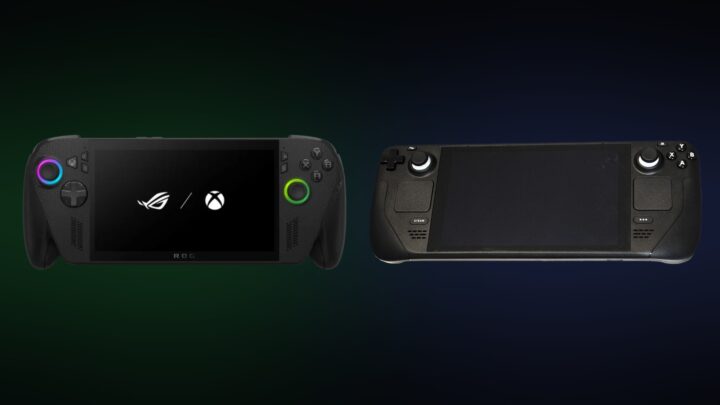
The Claw carries its own software layers. Engadget noted that while the fullscreen Xbox interface streamlines launching, users still juggle MSI Center M for profiles and lighting, Steam for games, and Intel software for setting frame targets in Endurance Mode. Neither handheld is an easy recommendation for total beginners. Readers who want a lower-priced starting point can check the $999.99 ROG Xbox Ally X and Steam Deck in our Xbox Ally X vs Steam Deck OLED comparison. One buyer defends MSI Center M, claiming it works better than critics state.
Gizmodo praised the Atlas’s ergonomics as spot-on despite a mushy flat D-pad. An early owner commended the Atlas’s comfortable rounded grips, while another buyer found its thumbsticks significantly better than the Claw’s. Engadget liked the Claw’s pronounced Xbox-style grips, but found its stiff metal-dome D-pad hit-or-miss.
Thermals, fan noise, and the battery reality
The Atlas rear casing gets hot, and Turbo fans sound loud.
During stress testing on the Atlas 8, PC Guide ran a 20-minute FurMark load alongside CPU stress tests in Turbo mode. The CPU settled at 35W and 62 C, while the GPU maintained roughly 22W after spiking to 77 C early. The rear casing and top vents got noticeably hot, though the hand grips stayed comfortable. The sound difference between Turbo and Quiet modes was surprisingly noticeable, even with a modest framerate loss. Gizmodo described the dual-fan AeroBlade cooling system as surprisingly capable, though the fans kick in and get loud after display timeout. I could not find published surface-temperature figures for the Claw.
Battery is where both fall short.
Battery life on the Atlas 8 requires real compromises. PC Guide tested Cyberpunk 2077 on the Steam Deck preset at 50 percent brightness, recording 1 hour and 30 minutes in Turbo (35W) and 1 hour and 40 minutes in Quiet mode (25W). Gizmodo logged under two hours in Turbo with Star Wars: Galactic Racer, 1 hour and 40 minutes at 35W in Gears of War: E-Day, and 1 hour and 55 minutes in Quiet mode with Mixtape. They noted manual 10W caps can reach past five hours, but battery life isn’t great on any power mode.
The Claw manages longer runs in Engadget’s Endurance Mode test. Engadget recorded over 3 hours of runtime in Clair Obscur: Expedition 33 at medium settings under Endurance Mode, and up to 4 hours in lighter titles. However, Endurance Mode requires setting frame targets inside Intel’s software, and multi-frame generation cannot be enabled alongside it. Because these outlets tested different games and power profiles, these battery figures are not directly comparable.
Where do the Ally X and X20 fit?
The Ally X sits $450 to $800 below the two at today’s prices.
The older AMD-powered ROG Xbox Ally X sits at $999.99, putting it $450 to $800 below these two Intel handhelds. Meanwhile, the ASUS ROG Xbox Ally X20 launched at $1,299.99 on October 15, matching the launch price of the Atlas 8, and sits $150 below the Atlas 8’s current $1,449.99 price at Best Buy.
Choosing between the Atlas 8 and the Ally X20 comes down to display preference versus raw performance. The Ally X20 features a 120Hz OLED screen pushing 1,400 nits peak brightness alongside TMR sticks, but Asus kept the internal specs of the 2025 model. Readers interested in operating system trade-offs can read our breakdown on SteamOS vs Windows handhelds in 2026.
Who should buy neither?
Do not buy either handheld if you play away from an outlet for extended sessions. At 35W power draws, the Atlas 8 dies in under two hours in heavy titles, while the Claw 8 EX AI+ reaches 3 hours only by capping the frame rate in Endurance Mode. Spending $1,450 or more on an 867-gram handheld that must stay tethered to a wall outlet defeats the point of portable hardware. If you need all-day battery life without tweaking TDP modes, pass on both of these Intel handhelds.
At what price gap does the Claw win?
Price decides this matchup.
The real issue is not peak frame rate; what the spec sheet hides is that these devices perform practically identically at matching wattages. What you are actually buying with the Claw is 8GB more RAM, 512GB more storage out of the box, an 83-gram weight reduction, and longer runs using Endurance Mode. What you give up is the Atlas 8’s better-reviewed thumbsticks, superior casing ergonomics, and lower initial purchase price. Note that Newegg also lists a different, cheaper MSI Claw 8 EX AI+ CG3M with a standard Arc G3 chip, 32GB RAM, and 512GB storage for $1,499, which should not be confused with the Extreme model.
As of November 16, the Best Buy-to-Best Buy gap is $350 ($1,449.99 for the Atlas versus $1,799.99 for the Claw), representing a 24 percent premium for MSI’s device. Newegg’s $1,709.99 Claw listing against Best Buy’s Atlas narrows that gap to $260, crossing below the $300 line. Above a $300 gap, the Atlas wins purely on price. If the gap narrows to $300 or less, buy the Claw. One European buyer claimed the Atlas 8 was not worth buying with 8GB less RAM when the regional gap was only about 50 euros (1,600 vs 1,650 euros).
At today’s $350 Best Buy gap, I would still take the Atlas 8, but only just. At $300 or less, which Newegg’s $1,709.99 Claw price already delivers against Best Buy’s $1,449.99 Atlas 8, I would pick the Claw for its 32GB memory headroom and 1TB storage. If the Atlas ever drops back to its $1,299.99 launch price, buy it immediately at Best Buy.


Comments